Competence: wonderful skill, terrible open bar policy

Being extraordinarily good at things will, if left at the will of others, eventually leave you buying all the beers.
Every woman, from the age of about 12, needs to understand that being extraordinarily good at things will, if left at the will of others, eventually leave you buying all the beers. More on the beers shortly. The point is, we grow up in a culture where it is somehow bizarre, even a little embarrassing, for a woman to expect something in return for her efforts. That needs to change.
Last week I ran the first of 4 masterclasses designed to help us understand why our health takes such a beating when we work our way into senior management, a time when we should be feeling absolutely amazing. I started with competence deliberately. The women who responded to our survey were bloody sensational at their jobs — visionary, community minded, extraordinarily capable. And yet something about the act of being so outwardly focused was also making them unwell. That felt like the perfect place to begin.
The masterclass elicited two rather overt winces. Turns out they were two sides of the same problem. The first is how much we give without thinking. The second is how little we allow back in. Fix only one and you won’t get a better result.
A short biology lesson
The second wince is worth a small biology lesson. Our bodies are designed to give and then to receive something back. That's how the complete cycle works: give something out, get something back, reset. The reset is somehow deemed to be optional for women. It’s not. It is the part that tells your nervous system that this particular effort is finished, received and acknowledged. Without it, your system stays open.
Consider the need for a reset like an open bar tab (you’ve made it to the beers bit). A tab that is yours and somehow always yours. You didn't plan it this way but here you are, buying round after round of pints for a table of people who have somehow never once reached for their wallet. You think you are being generous, but generosity implies a choice. What you have is a habit so old you've mistaken it for a personality trait.
That tab is your nervous system. Keeping it open is your system never getting the chance to close down, to switch off, to reset. It stays in a state of chronic activation, permanently scanning, bracing, getting ready for what's next. And it knows, with extraordinary accuracy, what you have spent and what has not come back. Over time, that open tab drains your resources in ways that are hard to ignore: you stop sleeping well, your immunity takes a hit, your hormones dysregulate, and burnout stops being a distant possibility and becomes a very real one.
The bill, I should tell you, is not cheap. It never is when everyone is sponging off you. The question worth asking is whether you'd like to close the tab yourself, at a time of your choosing, or whether you'd prefer to wait until your body closes it for you. One of these options, I can assure you, is considerably more pleasant than the other.
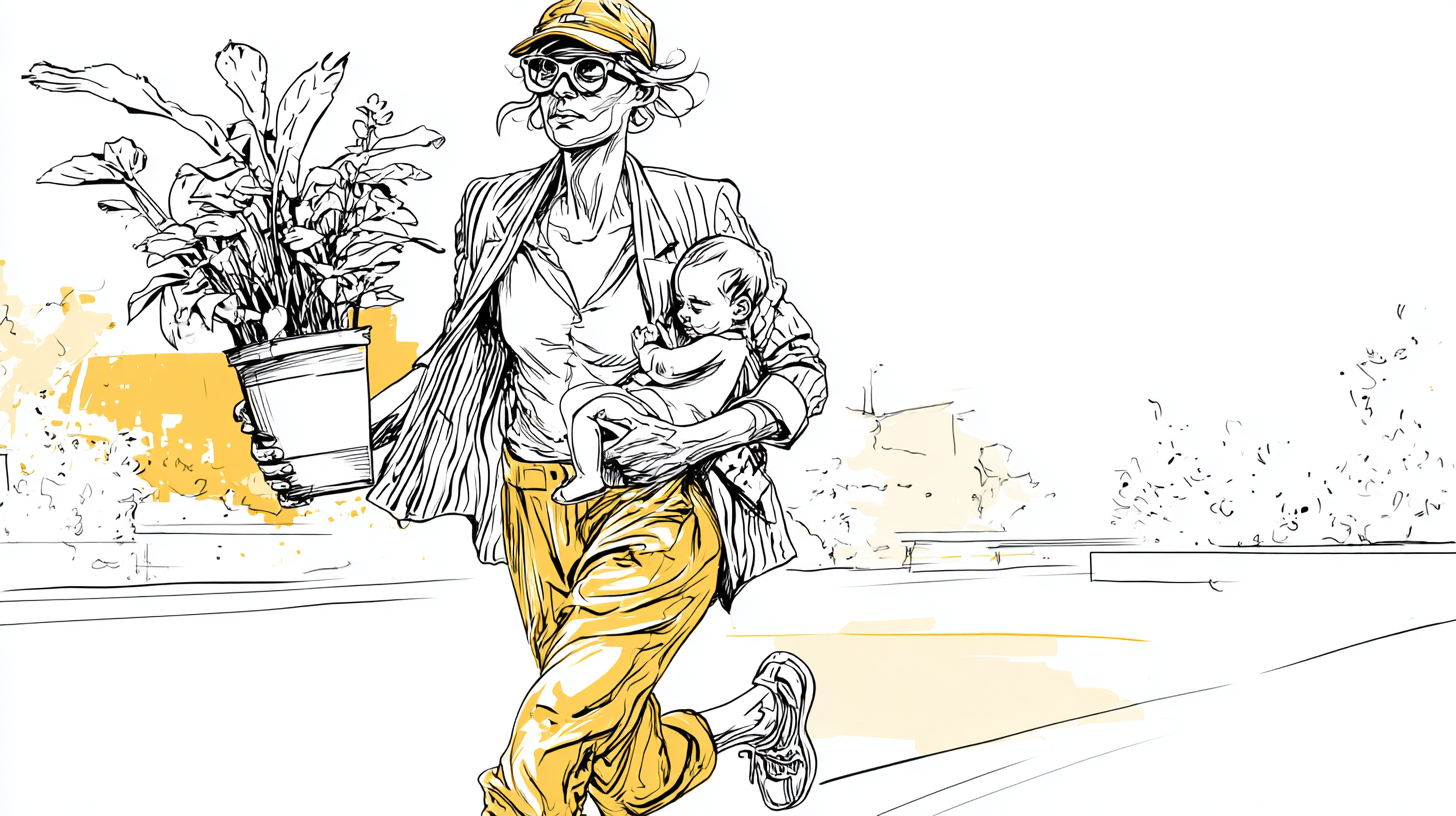
No-one can run ad infinitum, and neither can your nervous system
Your Nervous System Can’t Run Forever
Here’s another way to think about it. Picture a woman who has been running for four years - what a laugh, most of us have been running for so much longer. Now imagine her running, holding a pot plant, a baby, never stopping, never resting on a bench, never handing the baton to someone else, just running and running and running some more. No-one can run ad infinitum, and neither can your nervous system. But because our nervous system is on the inside somehow we’ve stopped noticing that we run it in the same way.
Which brings us to the bit that allows us to close the cycle. When we give we have to ask what comes back, but as skilled as women are in giving in the first place, we find it so much harder to ask what comes back. We've been taught that asking is greedy, that needing recognition is needy, that a woman who expects reciprocity is, at best, high maintenance. Biology disagrees. Reciprocity is your body's way of registering that this effort has been received, acknowledged and finished. No human body is built to give into a void, including the female one. And no one feels good buying all the beers.
A closing of the cycle can look like infinite things. Your kid thanking you every time you make a meal. A pay rise that reflects that you've taken on something much more complex than what you were doing before. A friend asking how things are going for you, rather than just coming to you because you are a great listener. The deep satisfaction of an orchid that finally flowers after three years because you decided to replant it. Nature is rather good at giving back. Human nature, less so, so you have to ask. Because when something comes back, the cycle closes and your system resets.
The work, and it is work, is learning to recognise where you will direct your competence before you deploy it, and to consider what will come back before you've already given everything away. This takes practice. In our masterclass we started to build that muscle of pre-emption. Because the goal is to make these decisions when you are calm and clear, not at the precise moment when you are about to explode in rage and frustration. That moment, as anyone who has been there will tell you, is not your best decision-making window.
I'm still working this out for myself, if I'm honest. Teaching yourself to think of your competence as something that deserves a fair return and then putting language around that takes time and craft. But I know that the women who came through our masterclass last week left with plenty of tools that I wish someone had handed me twenty years ago. And I know this too — when you learn to deploy your competence knowingly and expect something back, the lightness you feel, the calm in your system, is unmistakable.