Competence Is Doing a Lot of Unpaid Work
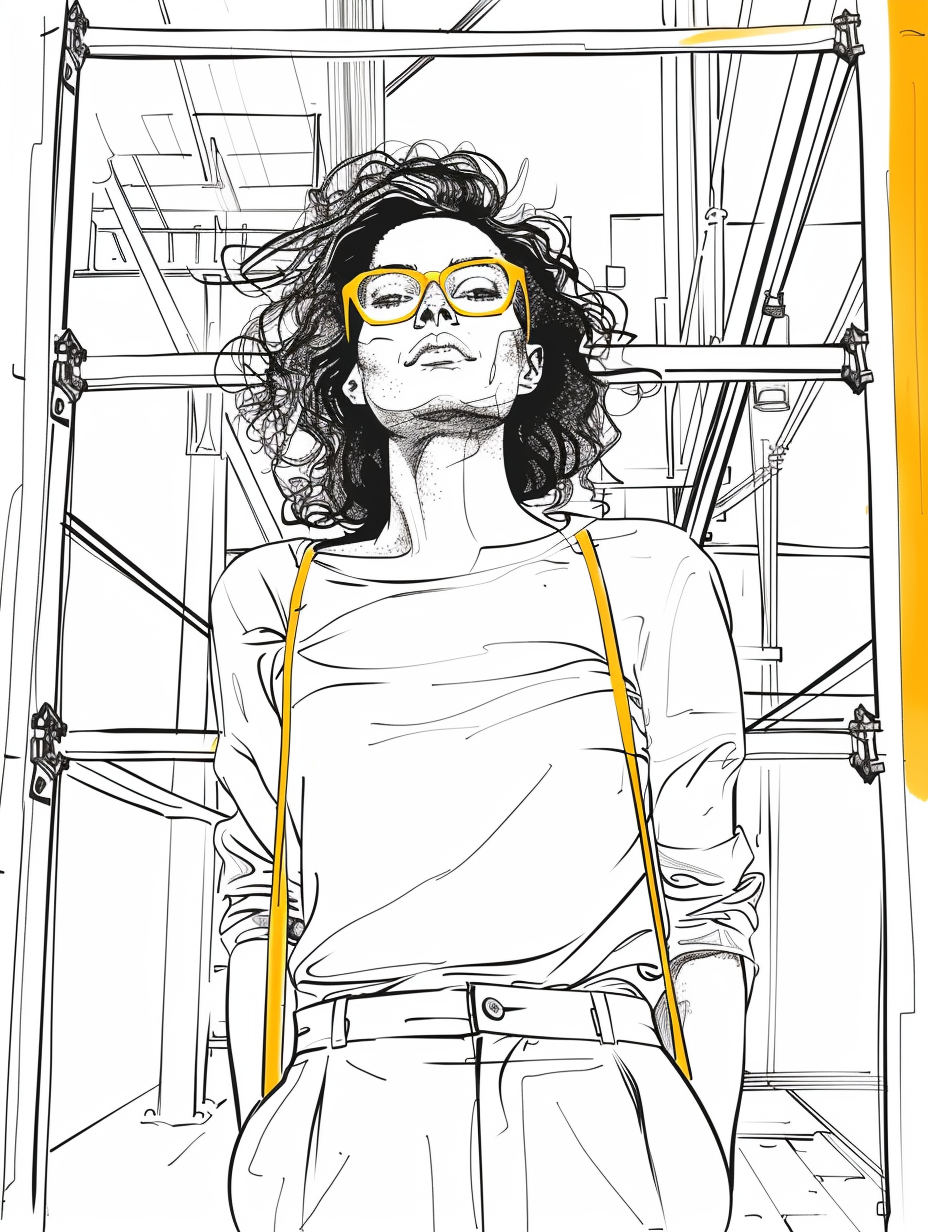
Image: The scaffolding that holds everything together also obscures the woman within it.
Here's a pop quiz:
How much toilet paper is in your house right now?
When was the last dental appointment that your family/your kids went to?
Which projects are actually on track vs just reporting green? Who is covering for someone else? Where is there unspoken tension no one has named? What will unravel if someone goes on leave? Who needs reassurance vs clarity?
Our 2026 research "Women and Stress: Life work and Everything in Between" determined that women tend to hold the answers to most of these questions, along with the answers to about 100 more. That women often carry the situational intelligence that keeps work and home life coherent, while others carry only the visible task in front of them—the doing, not the thinking, coordinating or remembering that makes the doing possible. How many of these could you answer? What about those around you?
It led me to another question: Is EQ female? It is certainly attributed to women. The research demonstrated the duality of this purportedly feminine attribute: the strength of emotional intelligence and the cost of being seen as the sex with "better EQ".
Is EQ Female?
If women aren't born holding the answers to these questions, where did this responsibility come from?
Many spiritual traditions have linked intuition to the feminine ideal. Taoism, for example, frames yin as receptive, embodied, cyclical and intuitive, paired with yang as active and directive. Modern spirituality carries this forward, often marketing intuition as "women's wisdom", tied to bodies, emotions and the unseen. This framing doesn't suggest that only women possess intuition, but it does show how cultures have repeatedly mapped it onto femininity.
Philosophy isn't so clear on the point. Some early thinkers valued knowledge that could be separated from the body (logic, essentially) and treated experience, emotion and intuition with scepticism. Later, Carl Jung explicitly linked intuition to the feminine, though not to women themselves. He described it as present in all psyches, encouraged men to integrate it, and largely assumed women already had it.
A modern feminist philosopher Carol Gilligan reframed the conversation entirely. Where philosophy had previously treated relational intelligence as secondary, Gilligan showed it was being judged by standards that valued detachment and hierarchy, and overlooked care, responsibility and relationship. The problem wasn't that women were doing it differently—the problem was that the measuring stick was designed to ignore what they were doing.
Science and psychology offer no credible evidence that women possess a special intuition gene or a mystical sixth sense. What the research does show is that women tend to score higher on interoception (reading the body’s signals), demonstrate stronger emotional attunement in social contexts, and are socialised from early life to monitor mood, threat, harmony and nuance.
Intuition is scientifically defined, rapid, non-conscious pattern recognition that comes from experience. It is neither magical nor gendered. Women often appear more intuitive because they do more of the noticing, tracking and relational holding. Over time, this placed women in effective ownership of this space.
How women reflect on their eq
The women we surveyed knew exactly how they'd ended up owning EQ.
"[It's] Two-pronged: Neurological: women wired to think ahead, consider others. Social: women care more and are not allowed not to care."
They noticed how quickly their EQ was dismissed as soft or emotional, how being perceptive could get you labelled as difficult, and how it could later be reframed as a strength once its value became useful to others.
Several women described the resulting experience as fractured—valued and exploited at the same time, and used to extend their capacity beyond what was sustainable. As one participant put it:
'Women care more and are not allowed not to care.'"
Women in the study described an invisible scaffolding surrounding the spaces they move through. The work of assembling and holding that scaffolding involved coordinating, anticipating, remembering, planning and switching contexts. This labour fell to them continuously, unacknowledged and unnamed. There is extensive literature describing this as cognitive load: a second and third job that goes well beyond the work in progress report or the household task list.
It's also clear to all women how rarely this work is recognised as work at all. It sits outside job descriptions, performance reviews and pay. It is not formally compensated at work, and it is rarely shared or acknowledged at home. Yet it is essential to how systems function. This is where women's competence becomes unpaid work. The more capable a woman is at holding complexity, the more of this labour accrues to her, without renegotiation and without relief.
This pattern is echoed in the Lean In/McKinsey Women in the Workplace Research 2025, which consistently shows that women take on a disproportionate share of emotional labour, people management and behind-the-scenes coordination, without corresponding recognition or reward.
Women described this load as being driven by emotional intelligence—the ability to read situations, anticipate needs, hold complexity and keep things moving. From the outside, this presented as competence. Someone organised, reliable and trusted. In many cases, it worked in their favour.
From the inside, the same skillset required constant attention. Women described scanning for what was next, what was missing and what might go wrong. Their attention not permitted to drop.
Here's an example from the podcast Ladies, We Need to Talk: a woman described her husband offering to do the weekly shop, asking what he should buy in the same sentence, then calling from the supermarket to ask where to find something. It never occurred to him to open the fridge, check the pantry, ask a staff member and work it out himself. The task was shared. The thinking remained hers.
Women in the research also described how this played out around time and boundaries. One woman spoke about being pulled into a Sunday pitch, while male colleagues sat around disengaged, avoiding responsibility, yet sharing credit once the work was complete. The pattern was familiar. The labour that kept things moving remained largely invisible, but its outcomes were attributed to all.
COMPETENCE BECOMES A BURDEN
The capable woman absorbs more, adapts faster and maintains equilibrium. The research suggests this often occurs at her own expense. One participant described cognitive load as "the thief of joy".
This incredible phrase captures the erosion that comes from a mind that never rests on itself - always scanning outward, always attending to someone else's needs.
To return to the scaffolding metaphor: scaffolding is meant to be temporary—functional, intrusive, but ultimately removed so the building can be seen for what it is. Women's scaffolding never comes down. What they're capable of remains obscured by the very structures that rely on their capability.
What could be leant on as a valuable skill suddenly turns into an expectation. Being good at something becomes synonymous with being responsible for it. Over time, this expectation creates a hidden economy of labour. Work that is necessary, skilled and exhausting, yet largely invisible and uncompensated.
The research makes clear that this unpaid work is central to how workplaces, households and relationships continue to function, and that everybody knows this. One woman put it devastatingly:
'I have learned that it is common and normal for people to take advantage of you.'
TRUSt THE SIGNAL
Many of the women who took part in this research spoke about wishing they had trusted their intuition sooner. Not as a resource for others, but as information about their own limits.
Women desire ambition without drag. They are asking to spend less of their day holding things together. Fewer hours reformatting the shared document so it makes sense. Fewer weekends absorbing the overflow of a disengaged colleague so that a deadline lands. Less mental bandwidth spent making sure there's milk in the fridge, the team hasn't drifted, the client feels reassured. More space to focus on the work that actually advances their ambition, and a life outside work that doesn't rely on constant vigilance to function.
Emotional intelligence is a superpower. One that has been created by, attributed to and put into great effect by women. The question this research leaves us with is this: What would change if emotional intelligence were treated with the same respect, boundaries and compensation as any other professional skill? What would change if the women who possess it could decide where to direct it, preserving enough for themselves to remain whole?
And perhaps there is a deeper question still. What would it take to build systems that acknowledge care as essential, rather than something optional? Can we design systems for humans who need health, rest and have limits—not systems held together by women making up for the gaps without recognition or relief?