FUCK, AM I ALIVE OR JUST MOVING?
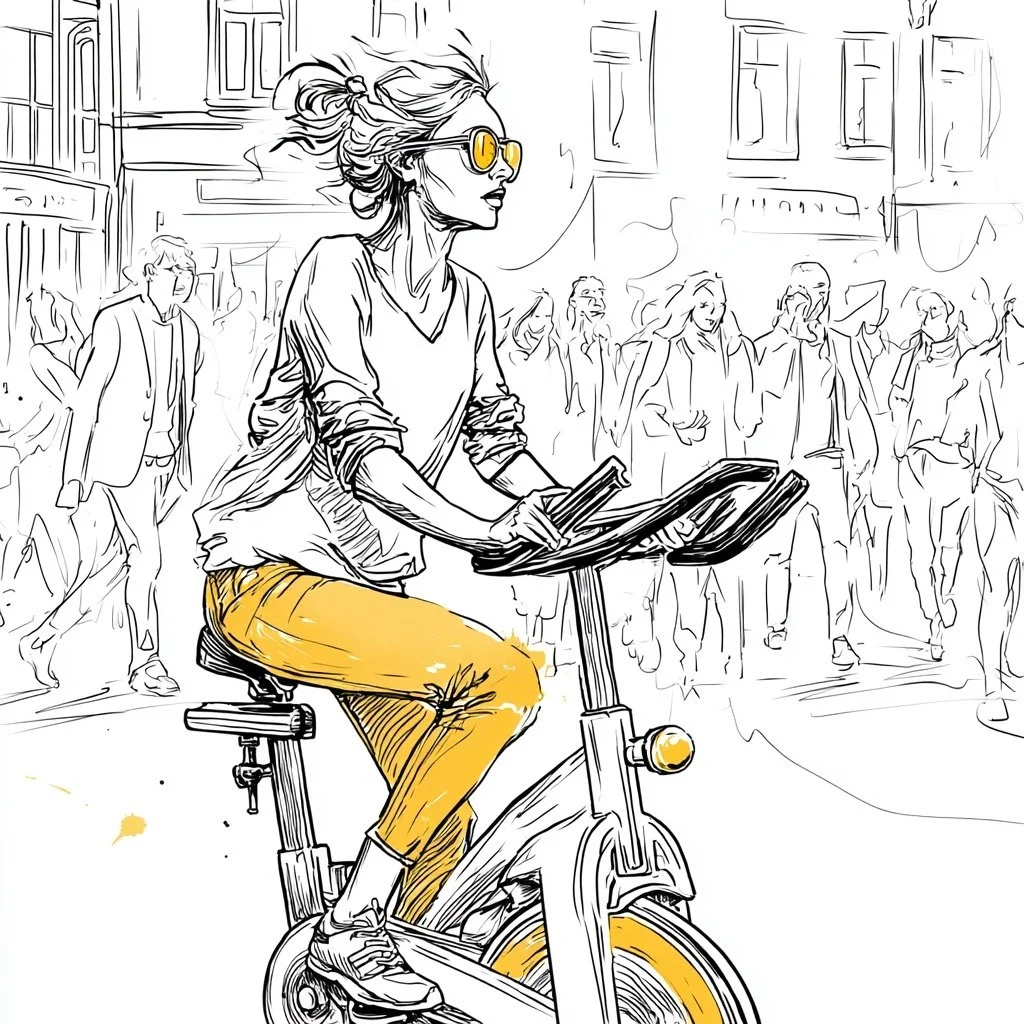
Image: A woman cycling on a stationary bike in the street — moving, technically, but not exactly living. The metaphor writes itself.
I learned about the concept of flow from a former colleague and advertising strategist, Matt Tanter. He wrote a brilliant strategy for an energy drink anchored in Csikszentmihalyi’s idea of that state where you’re engaged, almost engrossed, but not overwhelmed. Back then, I could explain it to our client but I don’t think I’d ever actually felt it. I understood flow intellectually, but I didn’t yet trust myself enough to recognise it in my own body.
Eight years after Matt taught me how to pronounce Csikszentmihalyi, I woke up with a sense of what I believe flow feels like. Just two months ago, my body and mind were alarmingly still. A bit parched maybe, but alert, grounded, able to move calmly and discerningly from the minute I got out of bed. My head wasn't already three steps ahead, calculating threats. My body wasn’t jolting into the day before I’d taken one deliberate step. I was here, awake and thirsty. The rest of the day followed the same texture. One thing at a time, no overthinking, noticing the small tasks and the more meaningful ones. You might call this presence. It occurred to me later that it came from very clear choices, in each and every minute in what I was doing. It felt like the first time my body trusted I wouldn’t drag it through a day based entirely on inherited priorities.
Movement Isn’t Living
Am I suggesting I’ve been on earth for 51 years without making choices? Not at all. I’ve made some good ones. It’s just that for years, decades really, so many steps were automated. The shoulds, coulds, musts, the fear-of-missing-out behaviours you absorb because that’s how society or work or family shapes you. I remember telling an aunt when I was 25 that I got ready the exact same way every morning and I said it with enthusiasm for this achievement. Same sequence, perfectly optimised. She replied, “That’s a bit sad.” At the time I didn’t see it. But looking back, it was the beginning of running my life on autopilot.
Motion as a defence mechanism. If you’re moving, you’re useful. If you’re useful, you’re safe. That was the logic. But I wasn’t alive, I was just moving. Some days my life felt like cycling on a stationary bike in the middle of a busy street — plenty of effort, absolutely no progress.
Byung-Chul Han describes how we live as “achievement-subjects,” people who come to understand themselves only through what they produce. Our motion becomes compulsory. We think we’re in control, but we’re the driver and the driven. Years passed like that, lots of tasks, but not a lot of choosing. And if you're not choosing, are you actually alive? Or are you just moving?
Here’s what I think was going on: when you’re exposed to too many messages for too many years, you lose the ability to tell which ones are actually yours. I never learned to filter out the noise — every request, every expectation, every opportunity, every “you should really think about…” felt like it needed attention. Jenny Odell writes about how our attention gets pulled from all sides, but for me it wasn’t just the pulling. It was that I had become so good at absorbing everything that I couldn’t hear myself underneath it. And when wanting and obligation blur together, you stop choosing. You just keep going.
My body walked me to a new life and I wasn’t even in it.
I’ve tried to recall the biggest moment of autopilot I didn’t register until years later and this was by far the winner: the day I left Australia for Amsterdam. I can’t remember it. Not the packing, not the morning of, not the airport, not boarding the flight, not even where I stopped over. Not landing in a new country and thinking “ah how exciting I’m here for this new life.” I just remember standing at my friend Melinda’s door, exhausted as her son let me in and dragged my massive suitcase up those immense Dutch staircases. My body walked me to a new life and I wasn’t even in it. It’s strange—moving halfway across the world without being fully conscious of it. But that’s what overdrive does. My system was saturated with pressure: What will people think? Is this right? Will I find work? Will my mother stop crying? I can always move back if it doesn’t work. My body managed the logistics of migration but I wasn’t there to witness it. Even my biggest decisions didn’t feel chosen.
It shouldn’t take crossing the world to realise you’ve left yourself behind, but that’s exactly what happened. Three times over — that’s some pattern, Eleni.
I needed a business coach to help me understand discernment. And therapy to learn that I didn’t have to take on what wasn’t mine. I’d lived so long through external measures—if it looked right, it must be right. Simone Weil wrote that “attention is the rarest and purest form of generosity.” I’d like to add that attention to yourself is the rarest form of self-respect. Discernment is refusing to give your attention to things with no claim on it. It’s the act of saying, “This is mine. That isn’t.”
Being discerning is knowing what resonates and what’s just noise. What Mary Oliver calls letting “the soft animal of your body love what it loves.” Not what it should love, or what looks good, but what it actually loves. And the reverse matters too: caring about things others ignore, things that aren’t impressive or productive. Things that matter to you simply because they do. I think that’s where the first signs of aliveness were coming from.
It took a toll. All that second-guessing and shape-shifting didn’t stay in my mind — it settled in my body.
The Question Finally Lands: What Do I Want?
My nervous system has been a fucking mess for years. Constantly elevated, making me sick with every flu imaginable, losing my hair, giving me brittle nails, eroding my sense of myself. Stephen Porges wrote about how the nervous system needs a baseline before we can feel present. I didn’t have that for a long time.
Two months ago, however, I wasn’t bracing, my jaw wasn’t tight and my shoulders weren’t knotted. I wasn’t running ahead in my mind. It surprised me because I'm used to being on guard. People call this “safety” but it felt more like not pushing past myself or overriding what I felt. With that pressure gone, even a tad, I could sense the difference between doing something I had chosen and doing something because I didn’t know how to stop.
Choosing has a different texture. Even when it’s effort, it feels steadier. When I act from a nervous habit or fear, it feels rushed and tight and now it seems my body knows the difference too.
When you don’t ask yourself what you want, you spend so long doing what needs to be done that you stop noticing what you ever chose. It sounds circular, doesn’t it? Large parts of the last 30-odd years are blurry; overdrive isn’t a good place from which to recall detail. When everything feels compulsory, you forget what you're surviving for. You forget that life is supposed to include some element of choice.
But that morning, without the familiar tension running the show, there was space for a question: What do I want right now? I had gone decades without asking it. When I finally asked, the answers were small: a walk today to move more than I did yesterday, to move slowly because the week had been full, to drink more water. It’s basic stuff, but relearning it feels like returning to myself.
I’m paying attention to these small choices. To see the difference between what I genuinely want and what I feel obliged to want or what Fritz Perls calls the “shoulds.” They shaped so much of my life: how to behave, what to pursue, what would keep things smooth. They don’t disappear overnight, but I can hear them now, and when I do, I pause.
Some mornings I feel that I have the energy to get a few things under my belt and I write early, I’ll cook a meal that I can eat for a few days, I’ll contact people in my new field and share ideas, I’ll plan. Other days I still feel volatile and I’ll want to walk first to calm my energy, or sit outside or read. Sometimes I want company after too much solitude. Other days solitude is the medicine. The answers change, but when I answer the question well it feels honest. The choices aren’t all gentle either, some of them close old doors. In time, even that feels steadier than before.
Autonomy research shows that people feel more alive when their actions come from their own preferences. When they don’t, they feel drained. This matches my experience more than I expected it to.
Autonomy sounds like a technical term. It’s really just the feeling of coming back into your own skin.
I’m practising small questions throughout the day that bring me back to my skin. What sort of thinking can my perimenopausal brain handle today? Do I crave human connection, and of which kind — professional or personal? Do I have the energy for yet another cold call? And I question deeply when I feel resistance, I try to understand it. Is it because it isn’t mine, or because it matters to me and I’m scared? They feel very different now.
These small checks have changed how I move through the day. I’m less on autopilot, I feel more like myself, there’s more ease now. Not much yet, but enough to recognise it when it appears. It’s slow, but thank Christ I can feel the difference now between being alive and just moving.
I spent 30 years moving and I want to feel the ground now. I’d quite like to try living.