The Push, Not the Dig
Glacial gains, and the moral supremacy of a Scandinavian breakfast.
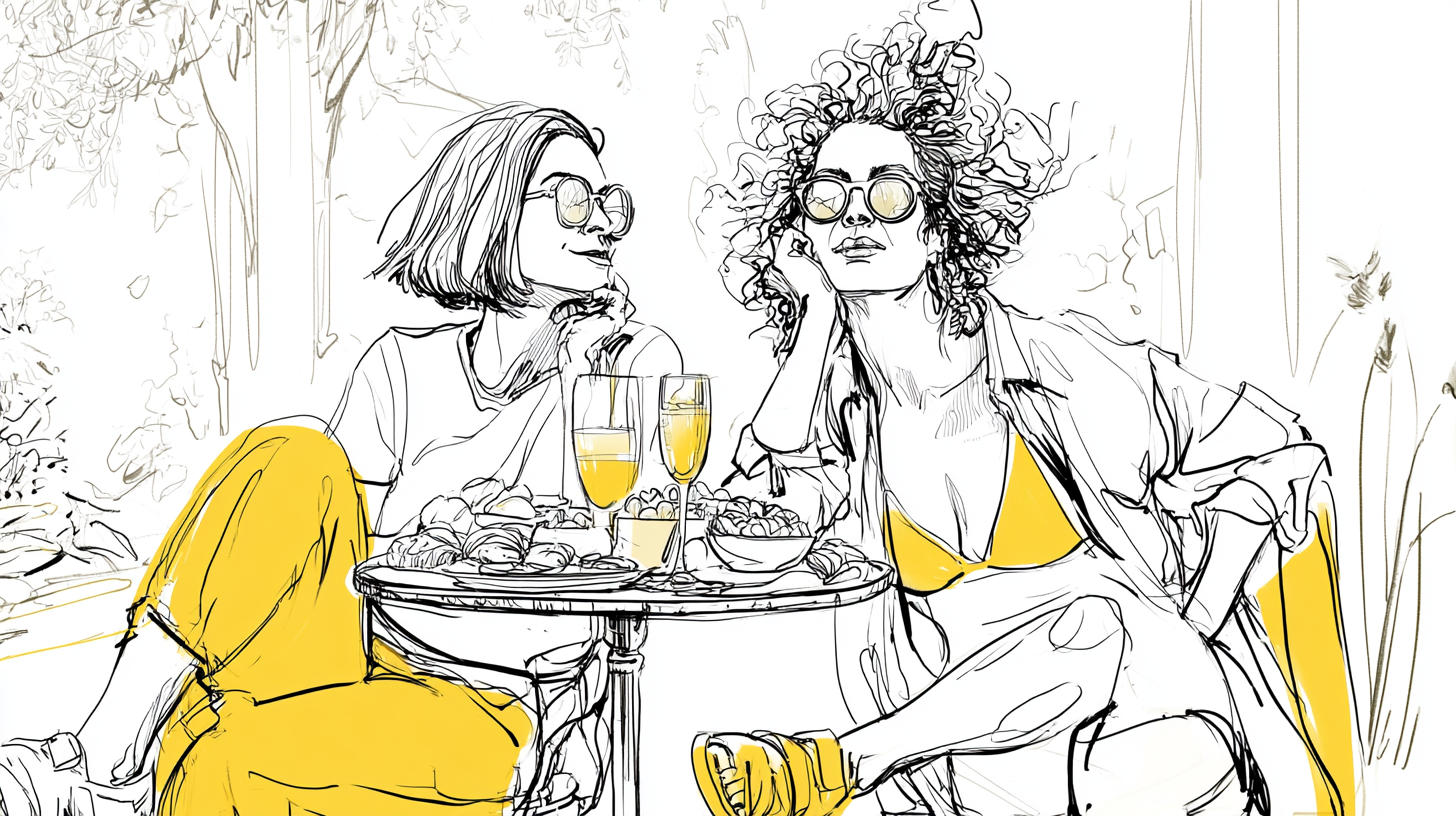
Image: Two women at the forest's edge, applying themselves to a Swedish breakfast of heroic proportions and a full post-mortem of last night's dinner among the trees.
When you kayak, the power doesn't come from the arm you think it does. You want to haul the paddle back like you are wrenching a stuck cork out of a recalcitrant wine bottle, all lower hand and brute effort. This, I learned, is the wrong approach. The forward momentum lives in the top hand, the one doing the pushing, and in the torso that rotates behind it, your lower arm a passive guide. If you get this right the boat moves, but get it wrong and you spend the next day negotiating any further participation with your shoulders.
I spent three of my seven days on the Lysefjord, pushing a plastic machine forward by inches against rock the size of Godzilla, and by day two was wondering which part of it was actually tiring. Was it paddling? Because the paddling was actually fine. Or was it the ongoing calculation of how vast the fjord was and how comically minor my progress against it?
Scientists who study endurance say what fatigues us is the perception of effort. Contemplating a thousand metres of granite (above and below the water), 10 km back to base camp, while you labour past it against the wind at roughly geological speed is, physiologically speaking, a way of exhausting yourself.
Right-sized problems
Beyond wearing you out, this vastness also does something more useful which is to shrink you. I read about this idea when I read Julia Baird's Phosphorescence, the book with which she wrote her way through cancer and which opens, fittingly, in the water, mid ocean swim off Sydney. She conveys the research, that awe produces what one scientist called a vanishing self. The theory is, stand in front of something enormous and your own concerns get right-sized. Baird's point is that awe is worth hunting deliberately and daily, rather than waiting for it to turn up, because it is one of the things that sustain you when the world goes dark. But note the words right-sized, not solved. Awe changes the scale of the thing, it does not lay a finger on the thing itself.
Somewhere out on the water, paddling beside Teal, a 68 year old American I had known for all of two days, I started to tear up, and so did she. Two capable women keeping up their strokes against a wall of granite, leaking at the eyes, not uttering a word.
a fjord, not my therapist
There is, as ever, a queue of things I have been turning over. A relationship with a father who can drive a person to homicidal turns of phrase. Self-employment, taken up for the first time at an age when most people are working on doing less. The ongoing project of a life in a city that makes no sense to many of those close to me. And then there's that chestnut of not having had children. All of it paddled out onto the fjord, and all of it paddled back, entirely unanswered, because a fjord is a body of water and not my therapist. The awe solved nothing but it did give my life concerns a proportionality, shrinking them against a billion tonnes of ancient rock until they seemed less of a load even for a short time.
in sync to the tune of nineteen quid
I did this trip with Clare, who is a superb human and the finest navigator one could ever travel with. The division of labour sorted itself out effortlessly: I drove and sketched the rough shape of our days, she handled the detail, the stops, which way we turned at that roundabout under the sea in the world's deepest road tunnel, whilst also in mid existential crisis at being 100m underwater and 3km in. We were so in sync that when we finally squared up Splitwise at the very end, two weeks of flights, accommodation, car hire, ice-cream from the hotel foyer fridge and car charging fees, the balance came out nineteen quid apart. 6 months of planning and expenses reconciled to within a rounding error. My accountant would weep.
A navigator who squares the finances to within nineteen quid is one thing. Someone who relishes the whole extravaganza alongside you is quite another, and Clare is both. We ran the days like a travelling two woman review panel. We opened at breakfast, which in Scandinavia is less a meal and more a moral position: an armada of rye and brown cheese and pickled everything and eggs and 4 types of yoghurt, loaded onto various plates in what became a daily three course meal. We closed at night with a full New York Times review of the day, what moved us, what mesmerised us, what earned its stars and what emphatically had not. The Norsk Oljemuseum: five stars for originality, care, rounded investigation and storytelling. The cruise ships squatting in Stavanger harbour like floating multi storey car parks: no stars (boo), an aesthetic misdemeanour against an otherwise faultless city. There is such pleasure in appraising the world out loud beside someone whose taste you trust, in having your delight witnessed and your objections ratified. Alone, and I've travelled alone a lot, the reflection is still there but it's thinner.
stop setting out alone
Which brings me to a less than fashionable trip conclusion. The embarrassingly simple learning from spending time with Clare is that there is something restorative about top and tailing your day with another person. Breakfast plotted together, the evening spent picking over what was wonderful and what was rubbish. 16 days of that and I came home clear-eyed about something that has been in the 'someday' pile for too long. Julianne Holt-Lunstad's studies put living alone on a mortality par with smoking, which means that doing this much of life in my own company may be worse for me than all the second-hand smoke I inhale daily in Greece, and that is a competitive field. I need to treat it as the real risk it is, a mission to be pursued with roughly the same vigilance I brought to planning this trip, rather than a someday I leave to chance. What that looks like I have no idea. I may even, God help me, go back to the apps. The thing I still want is someone as curious about my morning plan and my evening wrap-up as I am about theirs. Until that comes along, and probably long after, a Clare-shaped friendship for a fortnight a year is worth more than I can ever properly express.
it is worth asking for more
I came home relishing the plain, slightly smug fact of being strong, in the head and the body both. I can hike for hours with the 27 year olds. I can out-paddle a two-man canoe. The body does roughly what you ask of it, and I ask a great deal of mine.
An accident of latitude
I was warned the vistas would spoil me for every other trip. That wasn't quite the case. The vistas were wild, but wild beauty is everywhere. What actually spoiled me was communities built on care, on thoughtfulness, on respect for the self and other, on a decent chat, the Scandinavian honour system and a genuinely sublime morning food ritual. Beauty you can find everywhere. Care is the thing you have to build, as a choice a society makes rather than a happy accident of latitude, and the Scandinavians continue to make that choice in every children's park, museum and lakeside swimming platform, and yes, even in the debate around oil versus the environment.
imperfect athens resumed
On returning, the Athens airport queue evaporated my zen within 30 minutes. After two weeks of Scandinavian order this scene was less queue and more contact sport. So let me be honest about what a fortnight away provided. Many years ago I unlearned the reflex to treat a break as a fix, as though 16 days away resolves whatever is waiting on your personal or professional to-do list. The work is still the work, and still yours to do. A trip like this can however hand you some clarity around the priorities and how to address them properly, which is enormous, even if it is not the doing.
The lesson that survived this trip was push, not dig. This kayaking technique, which propels the boat forward when the force comes from the right place, now feels like a way of doing other things. It is how the friendships worth keeping work, both people paddling the same way. It is the whole Scandinavian bet, a society arranged so the effort lands where it rewards everyone, so nobody is left paddling alone. It is working actively toward more days shared at both ends, someone to plan the morning with and mull over highlights and lowlights in the evening. Rather than continuing to paddle alone and calling it independence, I need to stop setting out alone.
That is pretty much the haul from this trip: a sense of proportion, a deep desire to do less of life alone, and a restored faith that the common good is real, and more common than we are told. For a fortnight's adventure I think that is a very good return.
So, to the next trip. I am already planning it, and the brief is not where the best views are, but who ends up in the boat. Your suggestions are welcome, preferably ones that involve an excellent breakfast spread.